Notes from the engine room
Deep dives, design decisions, and field notes from the team building the context engine for AI-native development.
All posts 15
Four Cost Curves Are Collapsing at Once, and They All Point at Video
Inference pricing, GPU price-performance, video understanding, and vector storage are all falling steeply and simultaneously. Here's what each one is actually doing, the counter-evidence we take seriously, and the arithmetic for when continuously understanding a camera crosses under a real budget line.
7 min read
AI Is Going to Expose Bad Teams
Software bundles let teams borrow their judgment from vendors. When implementation gets cheap, the work that remains is defining correct behavior and proving a system exhibits it — which is the work we build tools for.
9 min readLess Than 1% of the World's Video Is Ever Watched
There are more than 1.5 billion enterprise cameras deployed and roughly 7 trillion hours of footage produced each year, and almost none of it is ever reviewed. The bottleneck was never sensing — it was that turning footage into answers required a human. That constraint is ending, and it changes what a camera is for.
7 min read
Context Engineering Is an Application Problem
Storage vendors are converging on "context engineering" as the reason to buy their database. The diagnosis is right — most agent failures are context failures — but the leverage lives in application code, not in a storage tier. Here's how we know, from running Redis at the center of a memory platform that keeps nothing durable in it.
7 min read
learn() and query(): Why the Next Database API Has Two Verbs, Not Four
CRUD asks you to predict your questions and encode the predictions as schema, then charges a migration every time you were wrong. Miriel's API replaces the four verbs with two — learn() and query() — and moves the structural thinking into the system itself.
8 min read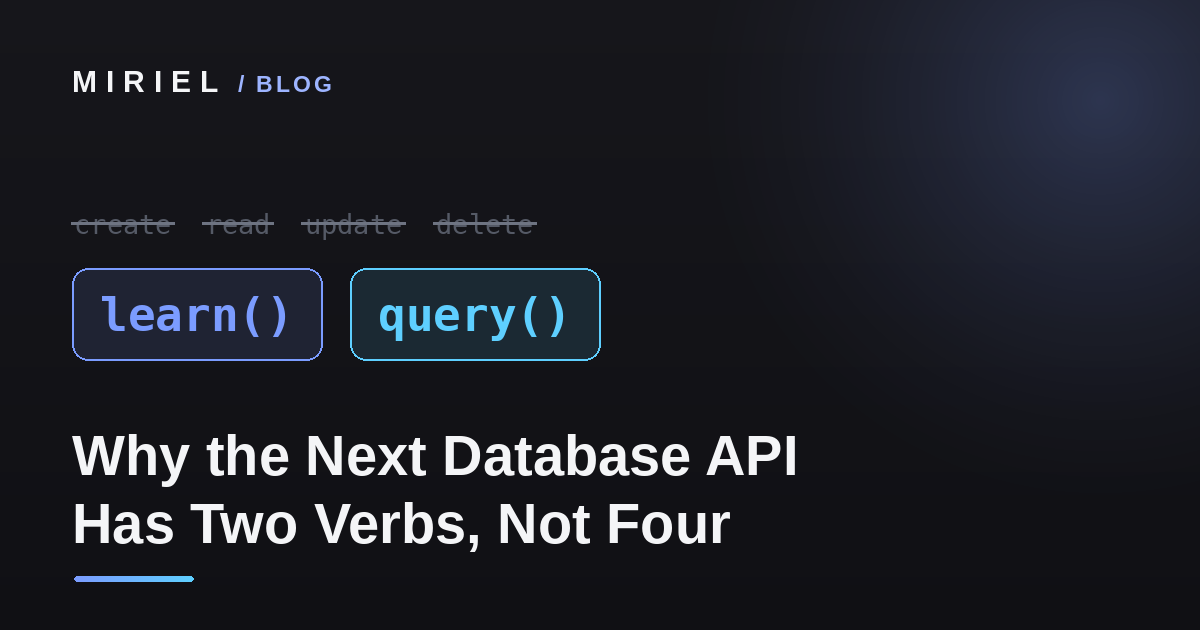
From 40 Million Tokens to a 450K-Token Graph: How Miriel Distills What It Learns
Every document Miriel learns is distilled into knowledge-graph triples by a small model, once, at write time. The result is ~89x compression of a whole mailbox for about $10, retrieval that joins facts across sources the way similarity search can't, and a memory that strengthens with use and fades without it.
17 min read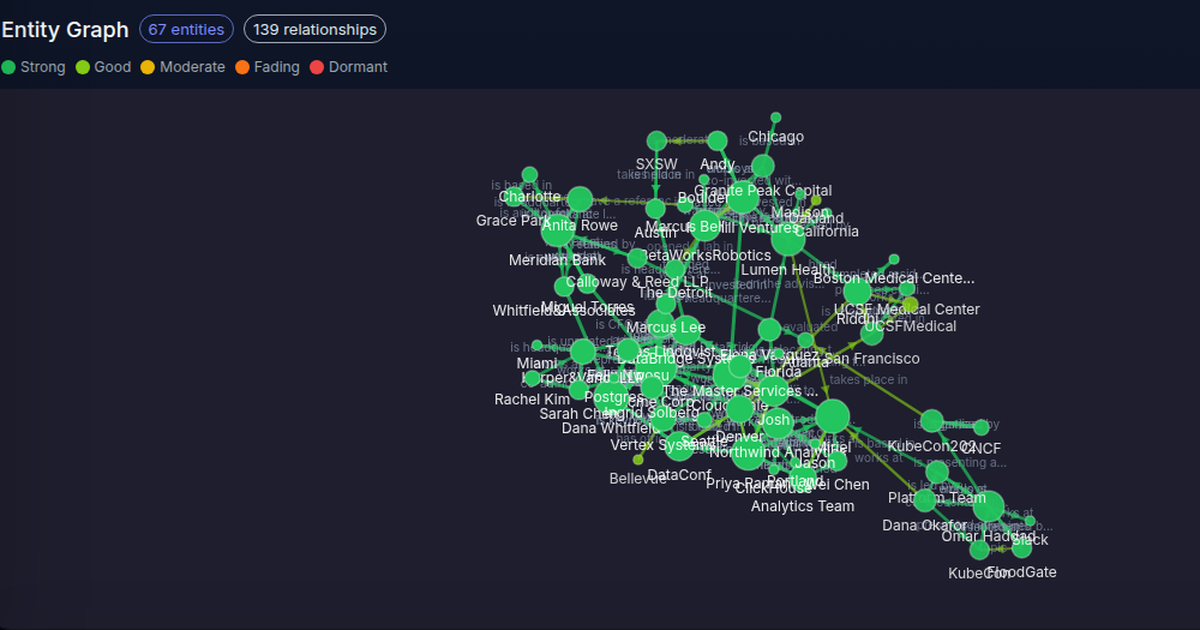
Code against the environment you need
A sneak peek at where we're taking autodev preview deployments: compose any set of services into one environment, and source each one exactly how you need it — a hermetic sandbox,…
5 min readYou Shouldn't Need a $1,000 Consultant to Change Your Own Website
Editing your own WordPress site still means paying an agency four figures and waiting weeks. In the age of AI, that's absurd. NexusBuild understands your site, migrates it somewhere you control, and lets you make the changes yourself — starting with WordPress.
3 min read
Nora at Work: A Visual Tour of the Floodlight Preview
We've written about how Nora is built — a reactive Voice and a deliberative Supervisor meeting at a blackboard. This time, we show her working: files as a navigable space, terminals and browsers as windows in that space, coding delegated mid-conversation, and interfaces synthesized on demand.
4 min read
Separating Dialogue from Deliberation: Nora's Two-Process Architecture
A conversational agent that also does long-horizon work has to reconcile two incompatible clocks. Nora — the agent inside Floodlight — resolves it the way an operating system does: a reactive Voice and a deliberative Supervisor that meet only at a blackboard.
13 min readAugmenting your AI coding agent with Miriel
An autodev agent reads your repo and GitHub for free; the things it gets wrong live everywhere else. Here's the integration pattern, and a reproducible side-by-side of the same task run with and without the Miriel context engine.
5 min readScaling Homomorphically Encrypted Face Search to 10 Million Vectors on GPUs
Building on an FHE facial-matching pipeline, we fixed a recall bug in the GPU search path, cut single-query latency by 3.4x, and scaled the search to 10 million encrypted vectors at about 1.2 seconds, validated against an exact brute-force baseline.
8 min read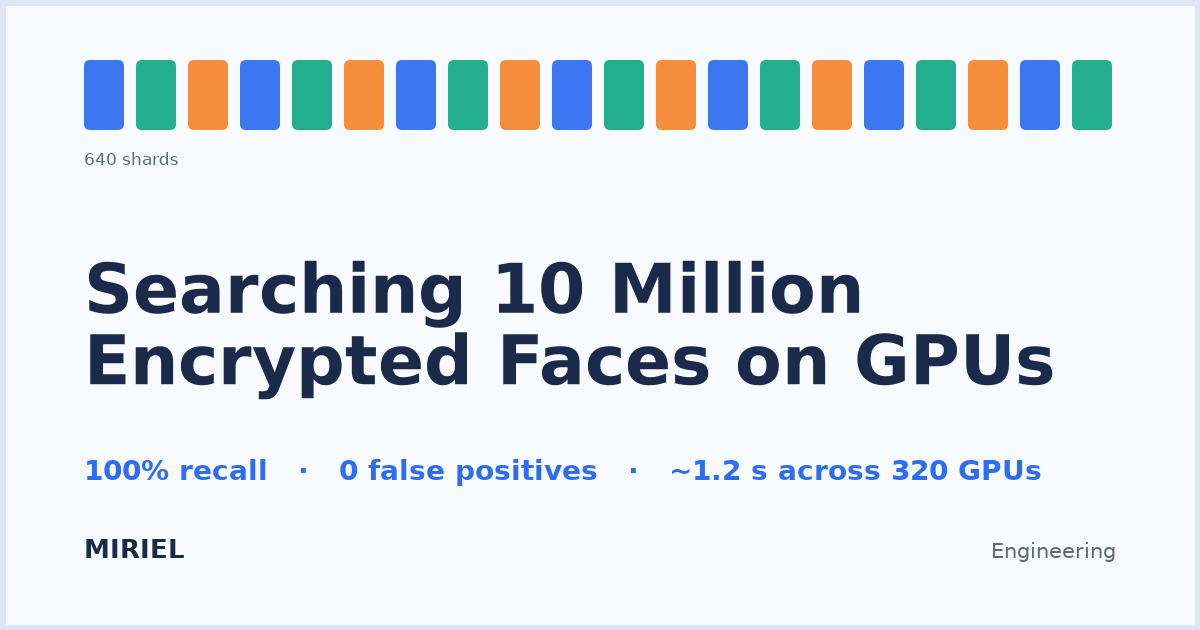
Accelerating Video-to-Vector Ingest to 8,000 Vectors per Second per Node
Accelerating Video-to-Vector Ingest to 8,000 Vectors per Second per Node By Madison Bratina Video now makes up the majority of the world's data, and making it searchable means…
8 min readSearching 100 Billion Encrypted Video Vectors: Why Search Latency Didn't Budge With Scale
How we scaled Miriel's confidential video search from one machine to a 20-node fleet, ingested 100 billion vectors at 37.5 million/sec, and kept search latency flat the whole way…
10 min read