"Cryptography" is really fundamental and important to computing.
"Crypto" is mostly scams and meme coins.
In the old days "crypto" meant "cryptography," and that's what Vinod Khosla is mostly talking about in this WSJ interview. If Vinod is right, and he often is, we will see the pressure on cryptography and cybersecurity not just increase, but accelerate.
Here's what he said:
"I expect we'll see quantum computers run Shor's algorithm well before 2030... As soon as we run Shor's algorithm... we'll be cracking most of cyber. And in fact, the Chinese have been collecting lots of data in the hope that they will have quantum computers that'll crack or decipher all that data."
And it isn't only quantum:
"The next four or five years will be totally chaotic in cyber. Why? Quantum computers is one reason, but an equally important reason, many of the algorithms will be cracked because we've cracked so much of math by the big models... First, they're great at cracking cybersecurity systems without cracking math. Then they'll crack math, then we'll have quantum."
He's positing that practical quantum computers (not just quantum annealers) will be combined with LLM-based AI to break virtually everything, in stages. He's also blunt about the fix most companies are planning. Post-quantum algorithms are "just saying, 'Let's make the math harder,'" and he expects most of them to be broken before 2030 too.
The attack has already started#
The part that deserves more attention is the second half of the first quote. You don't need a quantum computer to start a quantum attack. You need a hard drive.
Anything encrypted and copied today can be stored until the machine exists. Security people call it "harvest now, decrypt later," and there's no secret about who is harvesting. In 2024 the FBI and CISA confirmed that Chinese state hackers known as Salt Typhoon had broken into US telecom carriers, taking call records and getting into the systems used for court-ordered wiretaps (The Record). Back in 2010, China Telecom briefly routed a large share of the internet's addresses, including US government and military sites, through its own network (IEEE Spectrum). Encrypted traffic collected that way is useless today. Vinod's point is that it won't stay useless.
So the question for any piece of data isn't "when does the quantum computer arrive?" It's "will this still need to be secret when it does?"
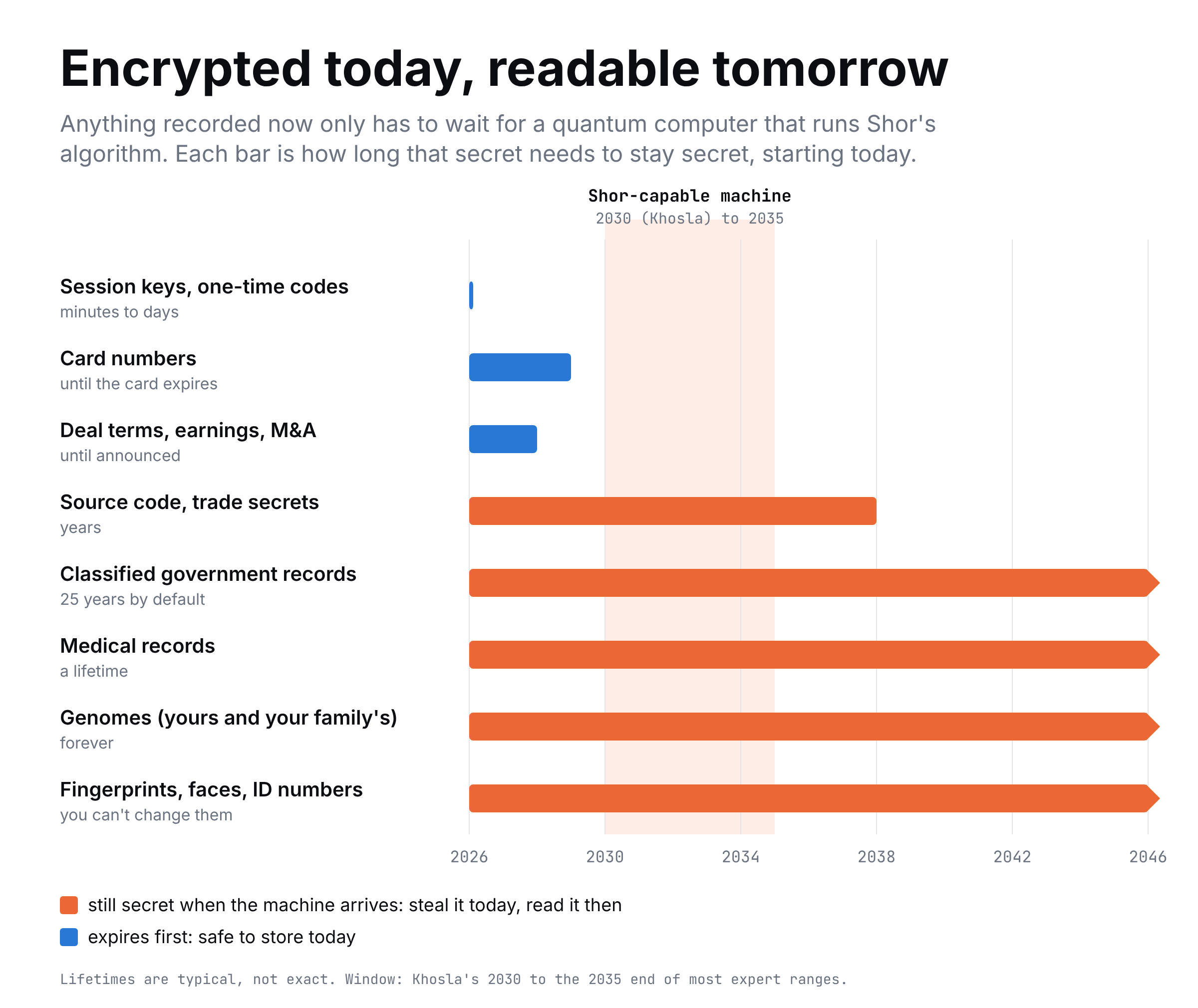 Lifetimes are typical, not exact. Window: Khosla's 2030 to the 2035 end of most expert ranges.
A stolen card number expires. Your medical history, your genome, your fingerprints and a government's intelligence sources don't. For those, the deadline was effectively whenever the data was first copied.
Not all encryption breaks the same way#
"All encryption can be cracked" is too blunt, and the details matter for what to do next. Different protections rest on different math, and they fall to different things.
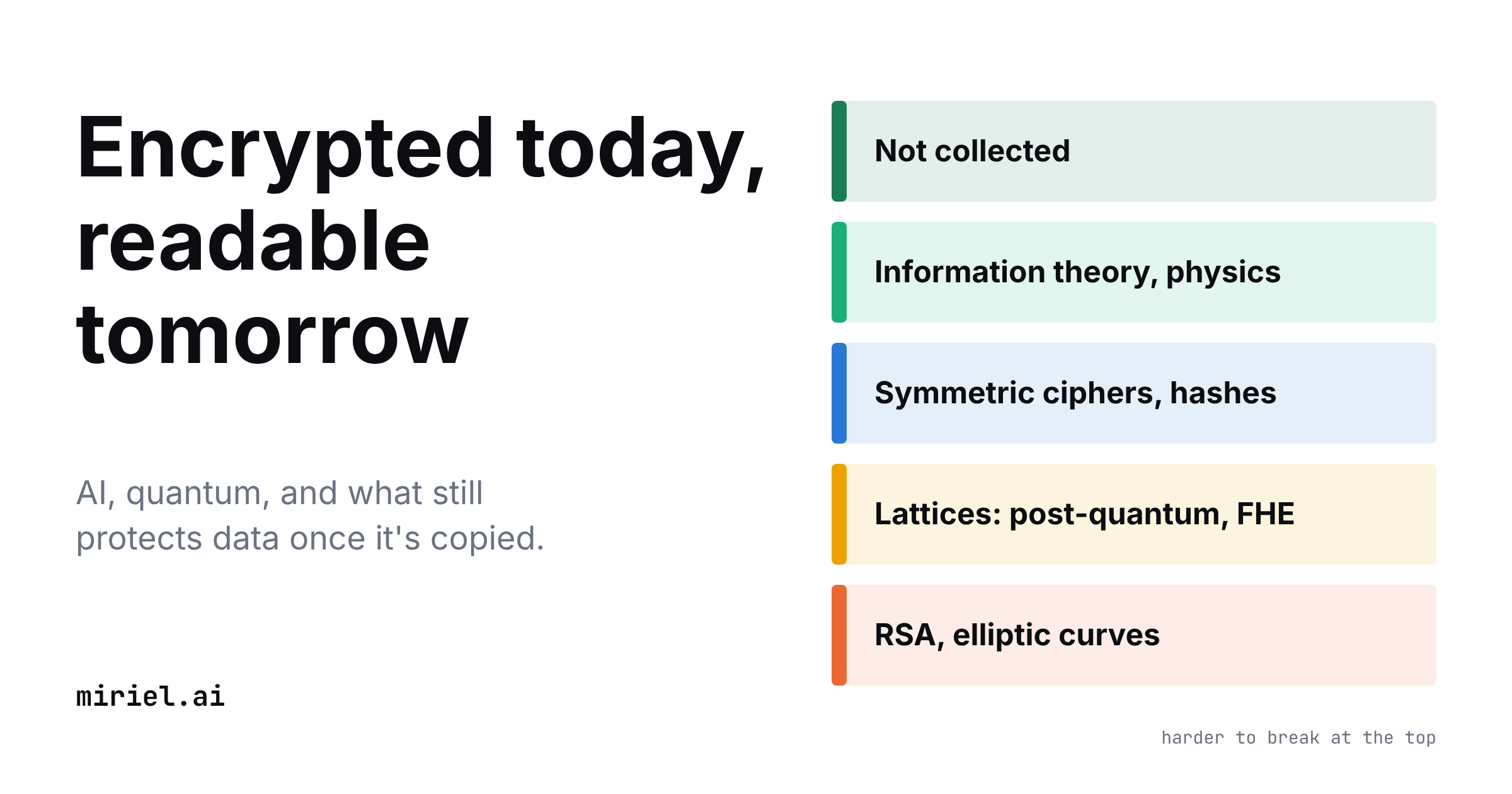
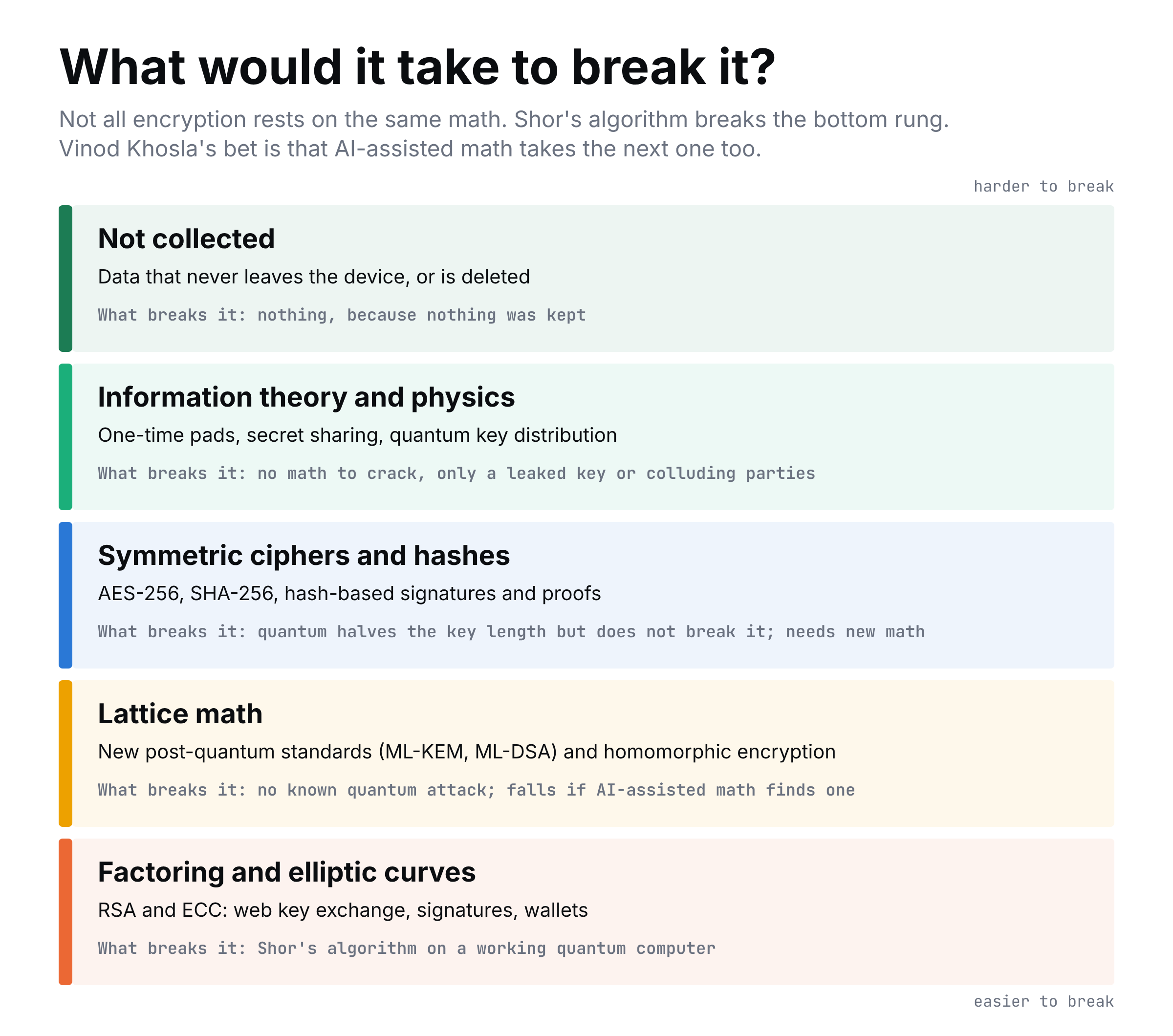 What each kind of protection rests on, and what it would take to break it.
- Factoring and elliptic curves (RSA, ECC) protect how almost every connection agrees on a key and how almost every piece of software is signed. Shor's algorithm breaks them. This is the rung Vinod's 2030 date is about.
- Lattice math is what the new NIST post-quantum standards use, and it's also what nearly all homomorphic encryption uses. No known quantum algorithm breaks it. Vinod's bet is that AI-assisted math will find a way.
- Symmetric ciphers and hashes (AES-256, SHA-256) are a different kind of object, with no hidden structure for Shor to exploit. The best known quantum attack halves the effective key length, so AES-256 behaves like a 128-bit key, which is still far out of reach.
- Information theory and physics don't rest on a hard math problem at all. A one-time pad, or a secret split among parties so that no one holds all of it, can't be cracked by any amount of computing. This is also where Vinod points for the long-term fix: "fundamental quantum security is not algorithms, it's quantum encoding," meaning keys exchanged over quantum links where eavesdropping is physically detectable.
- Data that was never collected can't be decrypted by anyone.
What a stockpile of ciphertext is actually waiting for#
Think about what's in that stockpile. It's ciphertext China can't read today, kept on the theory that it will be able to later, or at least that the rest of us will come to fear it can.
Most of it is less protected than it looks. The bulk of the data in a normal encrypted connection is scrambled with a symmetric cipher like AES, which sits high on the ladder. But the key for that cipher was agreed at the start of the connection using RSA or elliptic curves, the bottom rung. The key exchange travels with the data, so it's in the stockpile too. Break the key exchange with Shor's algorithm and you get the AES key, and then everything else. The strong lock is only as good as the weak envelope its key was mailed in.
So what matters for harvested data is which rung the weakest part of what was captured sits on:
- Today's TLS traffic, VPNs and email: the key exchange is on the bottom rung. This is what the stockpile is betting on.
- Post-quantum key exchange: the key is agreed with lattice math instead. Chrome and Cloudflare already turn this on by default for a lot of web traffic. Shor doesn't break it, so traffic captured with it only falls if Vinod's second prediction, AI cracking the math, comes true.
- Homomorphic encryption: also lattices, so the same rung. It adds something the others don't: the data never has to be decrypted on a server and sent back out under a fresh key exchange. What anyone can capture, at any point, is the lattice ciphertext.
- Keys that never travel: if data is encrypted with a symmetric key the owner holds, and that key is never sent over the network, there's no weak envelope in the stockpile at all. A harvester has AES ciphertext and nothing else.
- Data that never leaves the device: there's nothing to stockpile.
So where does homomorphic encryption, which lets you compute on data while it stays encrypted, actually help? It doesn't make ciphertext uncrackable, and if Vinod is right about AI and lattice math, it falls along with the post-quantum standards. What it does is keep data on a rung that Shor's algorithm doesn't reach, all the way through processing, instead of dropping back to the bottom rung every time the data is decrypted, used and sent somewhere else. Combined with keys that never travel, it leaves a harvester holding ciphertext that a quantum computer alone can't open.
And the fear matters even if the cracking never comes. Data that has to stay secret for decades, and was sent under RSA, is now a liability on someone's books. Regulators, insurers and customers will price that in long before anyone proves the stockpile can be read.
What happens in this world#
I think there are four huge things.
1. Edge computing may be suddenly more relevant and important. Data that never leaves the device can't be harvested on the wire or out of someone else's data center. That cuts against the last decade, when the economics pushed everything toward pooled cloud hardware, and for most work they still do. But for data that has to stay secret for decades, such as health records, biometrics and the contents of a home, keeping it local starts to win on risk. The likely result is a split: shared compute in the cloud, and the most sensitive data, and the keys to it, kept on devices.
2. Zero-knowledge proofs combined with hash-based cryptography. A zero-knowledge proof lets a system prove something about data without handing the data over: "this person is over 18," "this account can cover the payment," "this answer came from these documents." The proofs built on hashes, like STARKs, sit on the symmetric rung, which makes them among the most quantum-resistant tools we have. Every check that can be answered with a proof instead of a copy of the data is one less thing to stockpile.
3. Keep data on a high rung the whole way through, and keep moving it. That means post-quantum key exchange everywhere, keys that never cross the network, encryption that stays on while data is searched and used, and systems built to change all of it quickly (more on that below). Nothing captured today should sit on the bottom rung.
4. Collect less, keep it shorter, and verify the rest. The cheapest protection on the ladder is the top rung: don't keep what you don't need, and delete what has expired. For the software that has to hold secrets, Vinod's other bet is formal verification, mathematically proving code has no bugs. AI is making that practical, and he points out it cuts both ways: whoever formalizes a system first finds its bugs first.
Speed of adaptation now matters more than strength#
For most of computing history, cryptography changed slowly, and that was fine. DES was the US standard from 1977 until a purpose-built machine cracked it in 1998, and AES replaced it in 2001. SHA-1 was standardized in 1995, and the first practical collision came in 2017. RSA has been in use since the late 1970s. Algorithms lasted decades, migrations took a decade, and a security team could pick a strong scheme and mostly forget about it.
That rhythm is ending. When AI is finding bugs in systems and new attacks on the math, the gap between "a weakness is found" and "it's being used against you" shrinks from years to months, maybe weeks. In that world how strong your encryption is today matters less than how fast you can change it:
- Know where your cryptography is. Most organizations can't list every place they use RSA or which keys protect which data. You can't swap what you can't find.
- Make switching routine. Rotate keys on a schedule, re-encrypt stored data with new keys and new algorithms, and treat a change of scheme as an ordinary deployment, not a multi-year project.
- Never let one setting protect everything. Separate keys per customer, per dataset or per item mean a crack opens one slice, not the whole store.
This matters for the stockpile too, and that's the lesson of the last ten years. A stockpile isn't one locked box. It's millions of pieces, each locked with whatever key and method was in use the day it was captured. Where the same long-lived keys and the same methods protected a decade of data, one crack opens the decade. Had those keys been rotated, and the methods changed a few times over those ten years, the same stockpile would be split into many separate problems. Each key would be a separate job for what will, at first, be scarce and expensive quantum machines, and anything protected by a method that turns out to survive would stay safe. At least some of it would have been better protected.
The data being captured today is next decade's stockpile. Changing keys and methods often is how you make sure it's a pile of separate problems, not one.
Assume every rung is temporary#
The ladder above is a snapshot of what we believe today, and the whole point is that it won't hold still. Things are being cracked now, more will be, and with AI finding new math, protections we think are safe today will fall too. Vinod's sequence is AI breaking systems first, then the math, then quantum, and each step moves the bottom of the ladder up a rung.
So the honest plan isn't to pick the "unbreakable" scheme. It's to assume that anything captured today will eventually be read, and act on that: keep less, keep it for less time, keep it on the highest rung you can, keep the keys off the network, and be able to change your cryptography faster than the next rung falls. Crypto, the coins, is "the most vulnerable," as Vinod put it, but it's the smallest part of the problem. The bigger part is every medical record, every phone call and every corporate secret that has already been collected and is sitting in storage, waiting.
Disclosure: Miriel works with CyborgDB on encrypted vector search, and separately we've done work on homomorphic encryption.