I'm not really sure how Elon has convinced everyone that cooling servers in space is easy. It is not easy. And powering them is both easy and hard.
This matters for more than science fiction now. SpaceX trades on Nasdaq at about $140 a share, roughly $1.9 trillion, which is about 39 times what analysts expect it to bring in this year (Motley Fool). Data centers in orbit are a big part of the story behind that number: the IPO filing named them, and in January SpaceX asked the FCC for permission to launch up to a million data center satellites, on the claim that each tonne in orbit will carry 100 kW of compute (Tom's Hardware). So the physics of space data centers is now part of a stock price. Let's do the physics.
First, the power#
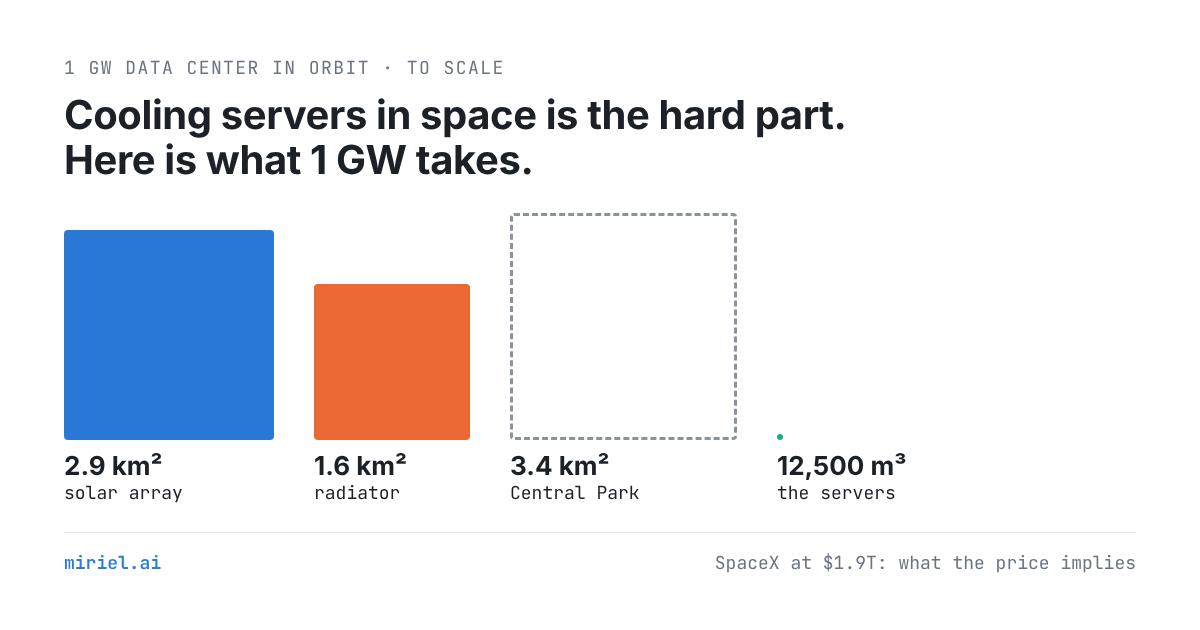
A typical hyperscale data center being built today is planned for around 1 GW. Above the atmosphere the sun delivers 1,361 W per square metre, and good space solar cells turn about 28% of that into electricity. After the gaps between cells, that's about 340 W per square metre.
- 1 GW takes about 3 km² of solar panels in an orbit that stays in sunlight, and closer to 5 km² in an ordinary low orbit, where you spend over a third of every lap in Earth's shadow and have to charge batteries for it. That's possible, but not easy. It would take years to build a 3 km² array, and that's only part of the battle. It powers maybe 500,000 servers.
- A typical POP, a small facility where networks interconnect with a few servers, might be 1 MW or less. That's 50 to 1,000 servers, depending on what they are. It needs about 3,000 m² of panels, a bit more than the solar arrays on the International Space Station.
This all changes if you can put a fission or fusion reactor up there that makes 1 GW. But that's not something we know how to do yet either, and for fusion it may be decades away.
Physical space for the servers#
Today's densest racks, liquid-cooled 72-GPU systems, pack about 80 kW into each cubic metre.
- A 1 GW facility is about 12,500 m³ of racks, and more like 50,000 m³ once you leave room to work on them. That's before power generation or cooling.
- A 1 MW facility is about 12 m³, a box a little over two metres on a side.
So picture a 1 MW facility as a small box with about 3,000 m² of solar panel and about 1,600 m² of radiator. Strung along a 30 m wide truss, it's around 150 m long. That is feasible.
The 1 GW version, laid out flat, is a structure 2 to 3 km on each side.
Cooling, the hard part#
On Earth you dump heat into air or water. In orbit there's nothing to dump it into, so you have two options: radiate it away as infrared, or carry something up, boil it, and throw it overboard.
- Radiating: a panel at about 37°C that radiates from both faces sheds about 650 W per square metre, after the sunlight and Earth's glow it absorbs. Every watt the servers use comes back out as heat, so 1 GW needs about 1.6 km² of radiator, and closer to 2 km² if you keep the coolant colder for the chips. We simply have no good method today for building and running a radiator that size.
- Venting: boiling water carries off 2.26 MJ per kilogram. Running 1 GW that way burns through about 15 million tonnes of water a year. That's roughly 150,000 Starship flights a year, just for coolant.
- Cooling a 1 MW facility is feasible: about 1,600 m² of radiator.
Try it yourself#
Set the size, split it into as many spacecraft as you like, change the orbit and the hardware, and see what it takes. The second half runs the other way: start from the SpaceX share price and see how much hardware in orbit it implies.
1 MW of servers needs 2,916 m² of solar array and 1,598 m² of radiator, weighs about 30 t and fits in one Starship.
Change the hardware assumptions
If 25% of a $1.9T market value is orbital compute, at 10× sales that business has to bring in $48B a year. At $20M per MW-year that is 2.4 GW running in orbit: 2,375 spacecraft the size of the one above, 71,712 t of hardware and 717 Starship flights, plus 48 flights a year to swap out servers as they age.
A thousand small ones#
If SpaceX launches 1,000 satellites and each one unfolds, or has drone bots build around it, a 1 MW facility, those 1,000 together make 1 GW.
Our estimate is about 30 tonnes per MW once you count the arrays, radiators and structure, three times the 10 tonnes SpaceX's filing assumes. Either way, 1 GW is a few hundred Starship flights, so if Starship hits its targets, the launches aren't the blocker. The blocker is that nobody has ever unfolded and kept running a single structure like this, with more solar than the ISS, and you'd need to do it a thousand times. And at the end you have 1 GW: a drop in the bucket next to what the industry builds on the ground every year. I don't think it happens in the next 20 years.
But even so, that 1 GW would have different failure domains and would be highly redundant. It wouldn't be subject to the jurisdiction of any one country. It would be 1,000 separate power, networking and cooling failure domains, almost entirely uncorrelated. And it would come with a mesh of 1,000 POPs to go with its 1,000 edge mini data centers.
If you have a critical load of just 100 kW and you want it to run somewhere very safe, you might happily pay 10 times more per server for that kind of redundancy. That's why I think space-based mini data centers do make sense: there's demand for them. But Elon is overselling when he talks as if they will solve our power, cooling and space problems any time in the next 30 years.
What this means for the SpaceX price#
Run the second half of the calculator with your own view. Here's mine at its defaults.
Say a quarter of SpaceX's $1.9 trillion is the market paying for orbital compute. A mature compute business at 10 times sales has to bring in about $48 billion a year to be worth that. At $20 million per MW-year, a little above what renting out GPUs brings in on the ground, that's about 2.4 GW running in orbit: roughly 2,400 spacecraft of 1 MW each, about 70,000 tonnes and 700-plus Starship flights. Then roughly 50 more flights every year just to replace servers as they age, because chips go stale long before solar panels do.
The flights are plausible if Starship works. 2,400 spacecraft, each bigger than anything flying today and each needing a working 1,600 m² radiator, is the part no one has shown. Morningstar's most optimistic valuation of SpaceX, about $1.97 trillion, needs exactly that, commercial orbital data centers plus a fully reusable Starship, and it gave that case a 7% chance (Wikipedia, IPO of SpaceX).
The business I do believe in is smaller. Say 100 MW of premium, redundant compute that sits outside any one country, sold at $50 million per MW-year to customers who'd pay 2 to 3 times the ground price for it. That's $5 billion a year, worth around $50 billion at 10 times sales. That's a real business. It's about 3% of today's market value.
So if you're valuing SpaceX, value Starlink and launch on their own numbers and treat orbital compute as an option. The things to watch:
- The first 1 MW-class spacecraft, and the radiator performance SpaceX actually measures on it.
- Tonnes per MW actually flown, against the 10 in the filing.
- Starship's flight rate and cost per kg.
- What customers pay per MW-year, and whether it's the redundancy and jurisdiction they're paying for, rather than cheap power.
This is a model to argue with, not a forecast and not investment advice. Prices and market value as of November 4, 2026. [DISCLOSURE: I do not hold a position in SPCX.]